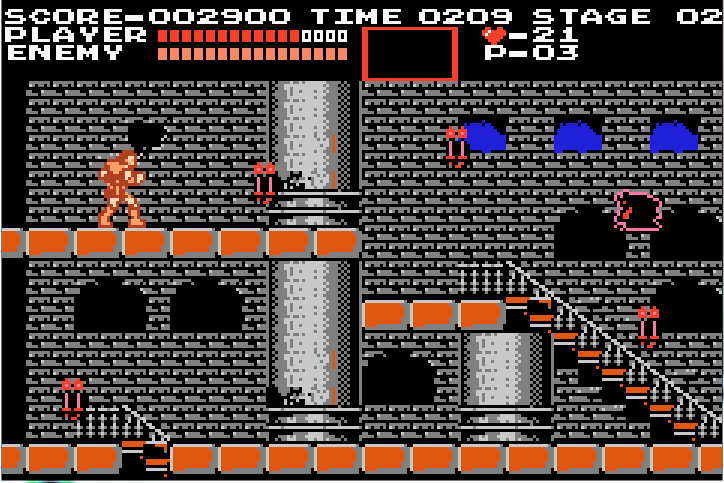
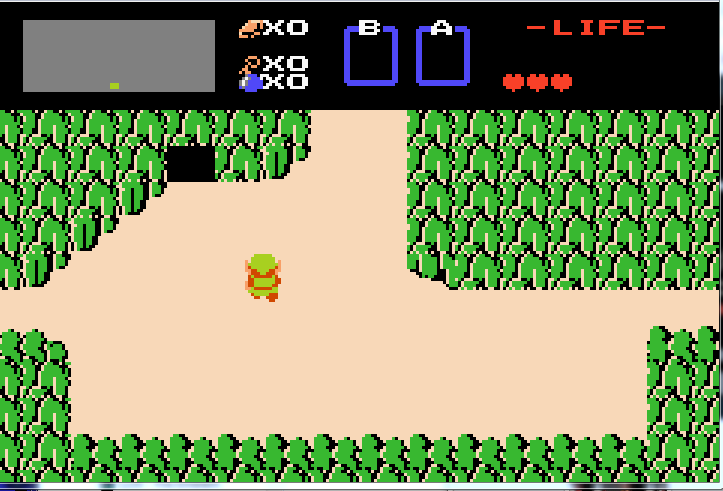
First off, again the clunky controls. I didn't figure out you had to use the 'select' command to move the selection tool, having been used to joystick commands moving the selection tool. I mean it worked that way in Castlevania. Again, this was an era where standard controls were still in the making, there was no universal A, B action button mapping. This game is from a time where sometimes A was jump and sometimes the up command was jump.
I get into the game and instantly find the classic old man cave where you learn 'caves have treasure! Go exploring in them!' and that the world you're in will require you to be equipped with a weapon, as the old man says 'It's dangerous to go alone take this!'
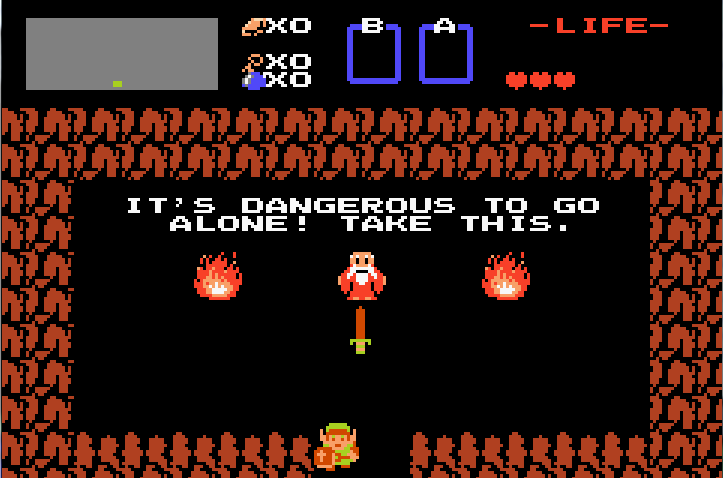
This seems a little more in game explanations orientated than Castlevania, since you're put in an environment where there is only one differing patch of pixels, so of course you go looking at it to find out what it is. The old man explicitly tells you that you have received something to fight off danger, and now to face the danger ahea- wait a moment there are lasers?
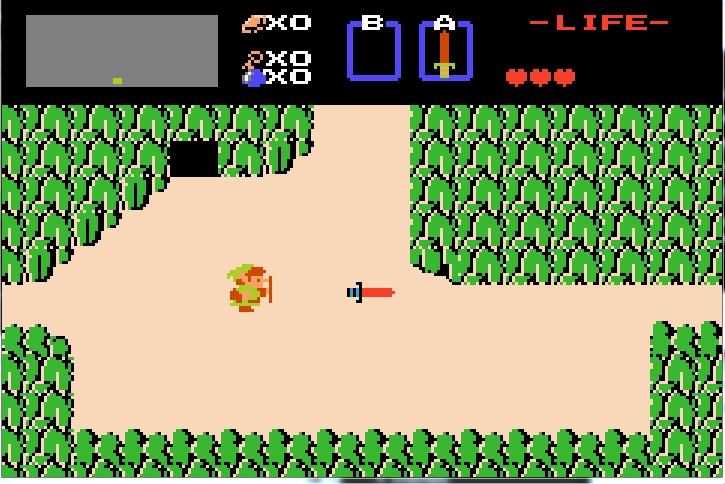
Old man you didn't tell me anything about lasers! I knew from previous game knowledge that you can only fire them when you have full health but I didn't know you got sword lasers right off the bat! Previously in games like Majora's Mask and Minish Cap they were a final upgrade to your weapon. But no you immediately have sword lasers, best of luck to your adventuring young sir, and may you zap your enemies with mystical cave-sword powers!
And, as is classic with Zelda games, we have a menu screen!
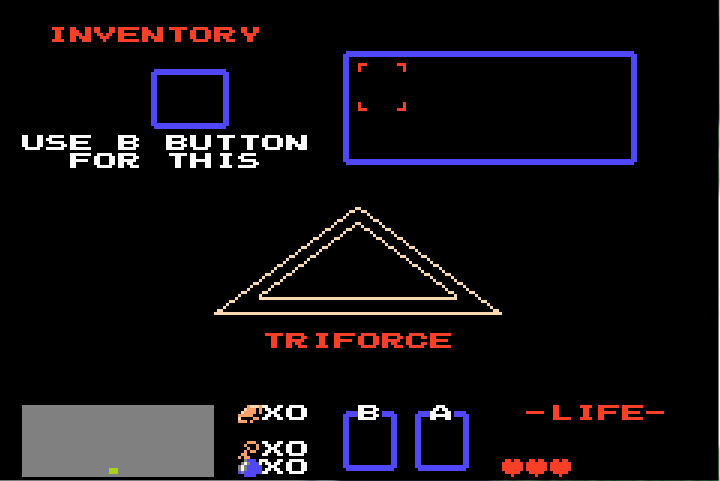
As you can probably tell I really love Zelda.
Back to game play features. So here we have 'Life' labeled out for us, which is pretty neat in case you weren't familiar with game life, or hit points. In Castlevania and a lot of fighting games like Street Fighter, you just got a health bar next to your name. When you get hit and you see the bar deplete, then you understand that it represents how many hits you can take before your 'life' depletes and it's game over. I guess it's interesting to have a 'score' on Castlevania, but I don't see much point in it beyond bragging rights and a new personal best 'score' Zelda also lacks a time limit, making the journey, and not the destination the key appeal to the stages, or levels. I feel like with a time pressure in Castlevania it was more important you reached the end in time than explored every secret or random drop available.
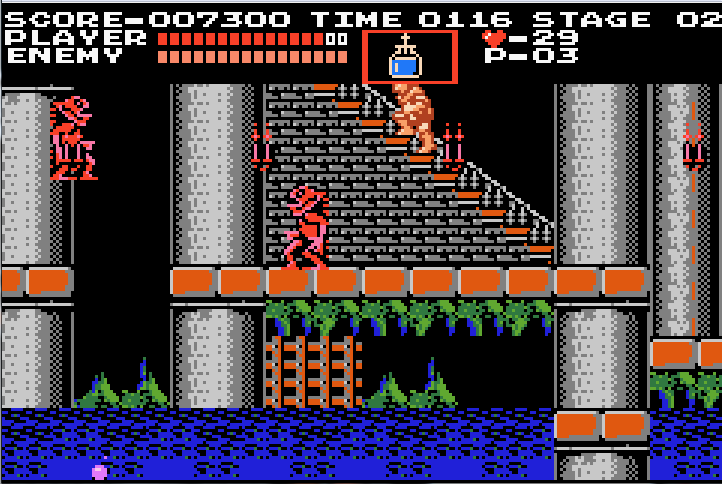
Additionally it was never really explained what 'hearts' were. They certainly don't replenish 'life.' It wasn't until the end of the stage that I found out they were score bonuses. instead health replenishing comes in the form of what the Game Grumps have influenced me to to call 'Wall Meat'.

But back to the Zelda menu. Boy that was a tangent and a half. Zelda is even more explanatory with the 'Use B Button for this' description. You could read the manual like a responsible Castlevania player would, or you could be so giddy you got a new game and completely forget about and hop right into the game and learn game mechanics on the fly until you beat the game and then read the manual to find out more.
Zelda even hints at the end goal objective with the empty 'Triforce' slot. Remember that big yellow flashing triangle thing on the game title screen? You'd think 'Yeah I wanna get that, looks like I'll have to look for it first though.' and now you have an end goal. Castevania you just kind of, go through places to find new things to kill until you find a really hard monster. Maybe if you had prior knowledge to the story of Dracula and read the novel you'd think the character might be Jonathan Harker with an Indiana Jones whip and armour about to rescue his Mina from being turned into Dracula's Stockholme Syndrome wife and ruin her 'purity' with his evil Transylvanian ways as xenophobic Victorian London was so gosh dang paranoid of. God protect the good Christian people from those impulsive foreigners ruled by lust and instinct. But no this is Simon Belmont, a guy you've never heard about in the novels, and Castlevania is not a game adaptation of Dracula it just reuses the setting and main antagonist of the original to create an interesting and new narrative with a familiar evil. However if you read the manual apparently Simon has a blood feud with Dracula, and wants to kill him to restore peace to Transylvania. I'd never have guessed. I mean you can just see the look of vengeance in Simon's dead, blank, pixelated non-eyes
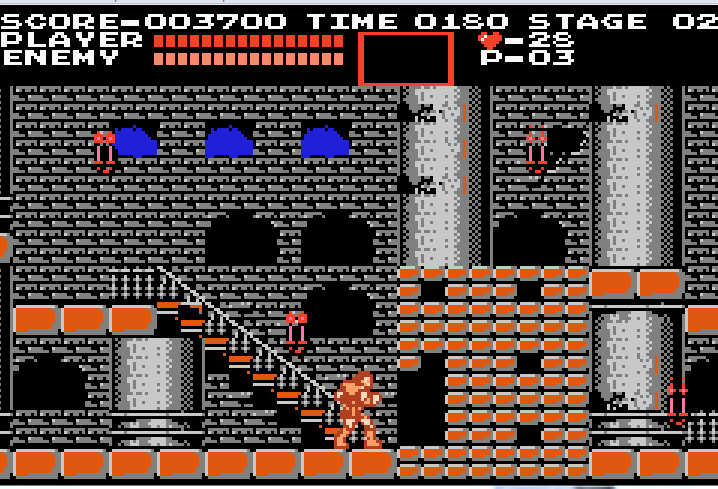
That wall meat was delicious.
But maybe i'm being a bit unfair, there probably wasn't enough sophisticated programming yet to tell the story Castlevania wanted to tell, so they had to print all the backstory in the all important manual.
ANYWAY AGAIN WITH THE SIDE TRACKING FROM ZELDA
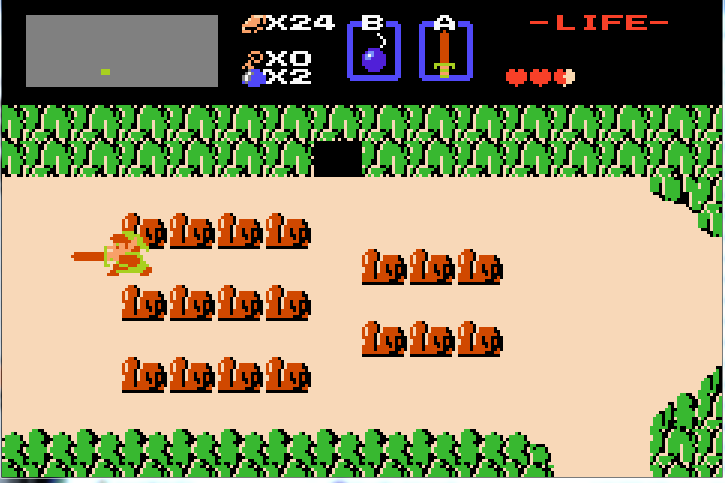
What I find interesting from Zelda is the near instantaneous reaction to pushing the A button Link would swing, and the swing would be over in about the same frame, and if not the very next frame at least. This gives the player more finely tuned controls as they can instantly react to an obstacle with little to no recovery time to react instantly to the death, or lack thereof of an enemy in succession. Swing once, instant hit, is the obstacle cleared? Instantly hit again. There is no waiting recovery period to remain exposed and vulnerable to enemy attacks. Zelda allows you to live in the moment without the need to plan ahead like Castlevania.
One thing I noticed, was the abundance of health
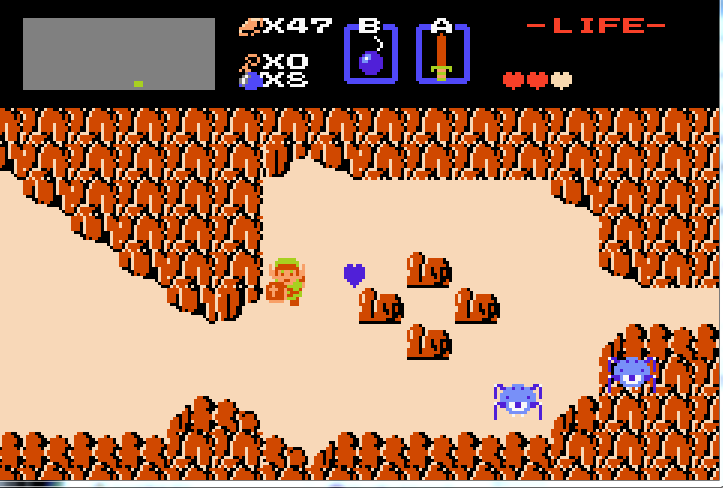
Understandably with a life count of three 'hearts' with a minimum damage of half a heat leading up to a max hit count of a whopping 6 is a bit unforgiving, so there is plenty of opportunity to heal up. From hearts, to fairies, to great fairies, Zelda wants you to live. It's a little misleading in Castlevania that the hearts are extra score points when we associate hearts with 'life' while the food actually heals you, but here in Zelda you see a line of symbols labeled 'life' so you know to get more life you have to get more of those symbols. The rules of the world of Zelda is a lot more intuitive and self explanatory. However there is a bit of lack in direction for Zelda, and it's clear why when you know the backstory of Miyamoto. Miyamoto wanted to create an open world to explore, hence the lack of direction. In Castlevania the stages had a clear direction. go away from where you started and eventually you end up somewhere important.In Zelda all four directions are open. In fact you start at the very bottom-center of the map. You can go to the four corners of the map to find adventure. Where you go and how far you travel is all up to you. The most direction I got was from an old hag in a cave once telling me to talk to the old man at the graveyard. Where is the graveyard in this huge place? What's with this world and old folks living in caves? Is there a hermit convention I'm not aware of?
Anyway I gave up trying to locate the graveyard when all I could find were deserts, rocks, beaches, and more cave people trying to sell me things I couldn't afford. The game pretty much tells you go look in caves to meet nice people and find neat things. Caves; Probability of finding loot and/or friendly old folks and dungeons: Weirdly High.
I do have to say the shield mechanic is weird though, because it's totally intuitive to face towards the danger you're running away from.