Unpack the first level of your chosen game (including cut scenes)
– how does it tell its story, and how is the player involved in the
telling (consider all of the narrative elements discussed so far in
the course)?
Hotline Miami tells the first part through a series of chapters and cut scenes. There is a prelude to chapter one, which introduces the player to the meeting room of animal masked men. The player is told unsettling information about the protagonist as not being very mentally stable, not even remembering his own name, and hint at some sort of self imposed memory suppression due to his actions being 'terrible things.'
The 'missions' are introduced by anonymous voice message, disguising 'hits' as innocent tasks.
The game is told through a series of story nodes, in which each storytelling element is spaced out by a mission with a mission objective (kill everyone). The player is involved in that all the violence plaguing the main protagonist causing his initial psychosis, is inflicted by the player in order to progress the unfolding of the story by completing the mass murder of a Russian Mafia.
The game is disorientating, in that familiar faces show up in missions, such as the tutorial man being killed in the first mission, and the animal masks being slowly accumulated through the game, while also being representative of the condescending persons in the protagonists' head. We also learn that our character's girlfriend has been murdered, further supporting the unbalanced nature of the protagonist, The game actively encourages violence, as the only way to progress through a level is to execute every person on the level, and each death is accompanied by copious amounts of blood, making murder seem satisfying and rewarding with a high score point ranking system. However, death remains narratively unglorified, as characters such as a black man near the end of the level crying out 'Please don't" before being murdered, are intended to make the player feel guilt. Ergo game play encourages murder, yet narrative disapproves of it. The game narrative is non linear, while game play is very linear, as each section of the game is divided up into game play and cut scene sections, one leading to another in a classic Jesse Schell string of pearls fashion, while the plot itself is told non-linearly, since the active game play is portrayed as a retelling of past events.
The game narrative is not dependent on the character in the first part, as it is a re telling of past events. The main protagonist has already suffering the mental repercussions of the player's actions, the player is only required for the main protagonist to relive his past horrors, to remind him of "who he was." and "what he did".
The final chapter of part one closes with the player seriously questioning the psyche of the main protagonist, as now recognizable masks, notably the chicken mask, ask the player almost directly 4 important questions. Do you like hurting people, who is leaving messages on your answering machine, where are you right now, and why are we having this conversation? Throughout, a myriad of bugs are scuttling across the top down perspective of the game, and a sickly yellow light representing decay and rot permeates the setting. The questions addresses both the protagonist and the player, since murder is made to be 'fun' and a way to accumulate points, and it was never yet revealed who, or even why the protagonist follows vague instructions as missions, and if the room, or even the conversation is being held in is real at all. It brings forth the question of the reliability of the protagonist as a narrator, and creates a sense of mistrust over narrative validity of the events unfolded in the past and in the present as a result.
Showing posts with label Interactive Narrative. Show all posts
Showing posts with label Interactive Narrative. Show all posts
Thursday, 7 April 2016

Thursday, 31 March 2016
Fez (2012)
As the player, do you interact with a character or an avatar
and how does this affect your involvement in the narrative?
Gomez is the main character introduced to the game, but h's a bit of both an avatar and a character. He is a character because he is an established citizen of his tiny town who already knows his neighbours, but he is also an avatar in that he is plain enough for the player to project their own characteristics onto him, even though we're given little. if any opportunity to do so, with most of the character 'interactions' being through Dot your 'guide'. The most emotion Gomez has to offer is an ecstatic 'happy' face when he accomplishes a goal, or plays with his fez/falls asleep on the floor in one of his long idle animations, showing off his childish personality.
Gomez suffers from a case of 'silent video game protagonist' and ergo, we cannot discern Gomez's thoughts on the possibility of his whole world and universe's imminent collapse. He isn't given the opportunity to express his own distress, confusion, or fear, or even any interest in starting an adventure. his emotions are instead left up to the player to project onto him and the player's motivations in the game narrative become his.
Gomez's status as 'character' from being an established character does not affect the game very much, as it is only a means to give Gomez a connection to Geezer who introduces him to the power of 3D game core mechanics. It's an underdeveloped bond between these two characters that stems from simply that the village, including Gomez are descended from the same people who were once gifted the view of 3D sight and that is the sole reason of connection, but Gomez is not aware of it yet. There is no further explanation as to how Geezer and Gomez know each other or why Geezer trusts Gomez with this power out of all the other villagers, but the brief backstory of a 'bond' simply creates an easier segway into kicking off the adventure, Gomez's identity as a character does not show much, nor does it impact the narrative of the game, since the village's identity is not very important to the overall narrative, as if the Fez was simply a magical artifact rather than a lineage-specific item any character could have been tasked with saving the world, descended from mystical village or not if the lore was changed so that anyone who had the fez could see the 3rd dimension, Therefore it is clear that Gomez is more of an avatar in nature, than character.
Gomez is the main character introduced to the game, but h's a bit of both an avatar and a character. He is a character because he is an established citizen of his tiny town who already knows his neighbours, but he is also an avatar in that he is plain enough for the player to project their own characteristics onto him, even though we're given little. if any opportunity to do so, with most of the character 'interactions' being through Dot your 'guide'. The most emotion Gomez has to offer is an ecstatic 'happy' face when he accomplishes a goal, or plays with his fez/falls asleep on the floor in one of his long idle animations, showing off his childish personality.
Gomez suffers from a case of 'silent video game protagonist' and ergo, we cannot discern Gomez's thoughts on the possibility of his whole world and universe's imminent collapse. He isn't given the opportunity to express his own distress, confusion, or fear, or even any interest in starting an adventure. his emotions are instead left up to the player to project onto him and the player's motivations in the game narrative become his.
Gomez's status as 'character' from being an established character does not affect the game very much, as it is only a means to give Gomez a connection to Geezer who introduces him to the power of 3D game core mechanics. It's an underdeveloped bond between these two characters that stems from simply that the village, including Gomez are descended from the same people who were once gifted the view of 3D sight and that is the sole reason of connection, but Gomez is not aware of it yet. There is no further explanation as to how Geezer and Gomez know each other or why Geezer trusts Gomez with this power out of all the other villagers, but the brief backstory of a 'bond' simply creates an easier segway into kicking off the adventure, Gomez's identity as a character does not show much, nor does it impact the narrative of the game, since the village's identity is not very important to the overall narrative, as if the Fez was simply a magical artifact rather than a lineage-specific item any character could have been tasked with saving the world, descended from mystical village or not if the lore was changed so that anyone who had the fez could see the 3rd dimension, Therefore it is clear that Gomez is more of an avatar in nature, than character.
Thursday, 24 March 2016
The Wolf Among Us
How does morality influence the choices you make in the
game?
Morality in the Wolf Among Us is easily distinguished between empathetic or apathetic responses. For example in the very beginning Toad complains about the hassle and complications of fables being constantly in glamour for the lower class, and you can choose to sympathize with Toad and tell him you'll let him off the hook, or you can reprimand him and threaten to send him to the 'Farm' the next time you meet. The primary response the game is trying to rope from us, is our desire to prove Bigby Wolf as a sincere individual to the townsfolk, a goal that is shared by Bigby himself as sated in the Book of Fables. Alternatively, we can flip this narrative and play Bigby as if he never changed from his old ways and gladly, even find pleasure in hurting others. The character's responses seem programmed to reprimand Bigby for every action in the game, trying to prompt you to redeem Bigby to them, however it can get tiresome and naggy at times.
You are expected to empathize with the denizens of Fabletown as they experience common lower class social problems such as never getting help from the government, the powerlessness of being essentially invisible citizens, thus their problems are seen as invisible, poverty, and government corruption. Even if the player has not experienced these hardships themselves, they are morally expected to sympathize with these very real world problems and attempt to try make life for the Fabletown citizens better. The game expects your first playthrough at least, to show that despite having the most supportive intentions and trying hard as you might to make morally right choices, life doesn't always go swimmingly and misfortune still befalls these people just like in real life, such as despite all the help you're offered to give Toad, the money, and promise of a second chance to afford a glamour and continue to live in Fabletown, through enforcement of law Toad is still forced to be evicted from his property with his son into the Farm, a place described as a prison. This disregard of moral choices affecting certain characters storylines makes it difficult to be properly motivated to make empathetic choices if all it's going to do is give characters false hope, thus my second playthrough of the game made it easier to be more stern and apathetic to Toad, in attempt to give him no pretenses that he would be exempt from the rules. The morality of following the rules as opposed to following your instincts is also challenged in this game, as multiple times if you do exactly what Snow White says in order to appease her, effectively the law, you're called her 'lap dog' and Georgie even wishes you'd 'come to your senses' if you choose to chase him first instead of the Crooked Man, where your choice to complete the specified, but not the most important objective, results in characters calling you an obedient dog sent to where it's told. Ergo this game encourages you to make moral choices over what path to take as opposed to the path you're explicitly told to take.
game?
Morality in the Wolf Among Us is easily distinguished between empathetic or apathetic responses. For example in the very beginning Toad complains about the hassle and complications of fables being constantly in glamour for the lower class, and you can choose to sympathize with Toad and tell him you'll let him off the hook, or you can reprimand him and threaten to send him to the 'Farm' the next time you meet. The primary response the game is trying to rope from us, is our desire to prove Bigby Wolf as a sincere individual to the townsfolk, a goal that is shared by Bigby himself as sated in the Book of Fables. Alternatively, we can flip this narrative and play Bigby as if he never changed from his old ways and gladly, even find pleasure in hurting others. The character's responses seem programmed to reprimand Bigby for every action in the game, trying to prompt you to redeem Bigby to them, however it can get tiresome and naggy at times.
You are expected to empathize with the denizens of Fabletown as they experience common lower class social problems such as never getting help from the government, the powerlessness of being essentially invisible citizens, thus their problems are seen as invisible, poverty, and government corruption. Even if the player has not experienced these hardships themselves, they are morally expected to sympathize with these very real world problems and attempt to try make life for the Fabletown citizens better. The game expects your first playthrough at least, to show that despite having the most supportive intentions and trying hard as you might to make morally right choices, life doesn't always go swimmingly and misfortune still befalls these people just like in real life, such as despite all the help you're offered to give Toad, the money, and promise of a second chance to afford a glamour and continue to live in Fabletown, through enforcement of law Toad is still forced to be evicted from his property with his son into the Farm, a place described as a prison. This disregard of moral choices affecting certain characters storylines makes it difficult to be properly motivated to make empathetic choices if all it's going to do is give characters false hope, thus my second playthrough of the game made it easier to be more stern and apathetic to Toad, in attempt to give him no pretenses that he would be exempt from the rules. The morality of following the rules as opposed to following your instincts is also challenged in this game, as multiple times if you do exactly what Snow White says in order to appease her, effectively the law, you're called her 'lap dog' and Georgie even wishes you'd 'come to your senses' if you choose to chase him first instead of the Crooked Man, where your choice to complete the specified, but not the most important objective, results in characters calling you an obedient dog sent to where it's told. Ergo this game encourages you to make moral choices over what path to take as opposed to the path you're explicitly told to take.
Thursday, 17 March 2016
Fallout 2
Do the choices made in the game result in branching
narrative paths? If so, how? If not, how are the choices
meaningful?
Fallout 2 having the mechanic of modifying your character's traits to be more diplomatic or combat based allows for different styles of gameplay. However the beginning sequence of Fallout 2 is still rather linear, as the only way to unlock different dialogue options is to increase intelligence or other speech enhancing skills, and the only way to progress is to complete a linear mission. There is no alternative way to complete the first mission, However there are multiple pathways that can be completed in this open world. However only a few endings are considered 'canon' as a continuation of the series, thus there are only a few select events that truly have happened, that the player should set out to achieve. Likewise there are still only a few 'happy' endings and thus few of the endings are actually impactful to the overarching story of the series.
Fallout 2 having the mechanic of modifying your character's traits to be more diplomatic or combat based allows for different styles of gameplay. However the beginning sequence of Fallout 2 is still rather linear, as the only way to unlock different dialogue options is to increase intelligence or other speech enhancing skills, and the only way to progress is to complete a linear mission. There is no alternative way to complete the first mission, However there are multiple pathways that can be completed in this open world. However only a few endings are considered 'canon' as a continuation of the series, thus there are only a few select events that truly have happened, that the player should set out to achieve. Likewise there are still only a few 'happy' endings and thus few of the endings are actually impactful to the overarching story of the series.
Thursday, 10 March 2016
Never Alone
Chosen question
Do the story nodes in your chosen game(s) work well to support gameplay and gameplay objectives? Why or why not?
Story nodes in the beginning of Never Alone take the form of cut scenes and exposition.
The initial cut scene introduces the world and the characters, however keeps it very vague, as we the players are constantly encouraged to explore deeper into Inuit mythology by the owl giving us the option to view certain clips and images to explain the mythos. However, as the developers understood that not every player would be as invested in the mythos and providing so much information could be distracting from game play, the choice to make this information optional is much appreciated.
Each cut scene and narrated segment we are given provides an objective, and dictates the mood of the scene. 'The girl was devastated' at the destruction of her village or 'The owl man was delighted' to have his drum back. It's a bit like taking a walk through this linear story book, only you can feel real tension in tense areas of the story because you, the player are capable of failure and dying, unlike in a story book where the survival of the main character is presumed to be guaranteed. However I feel as though narrated events where the player is still able to move, such as the bear den, could be better narrated to support game play rather than 'it is not easy to outsmart a bear', as this is a bit of trivial commentary basically telling the player 'here is a puzzle, you're on your own.' The moment the antagonist is chasing the girl is also narrated as 'he was more enraged at the sight of the bola' which tells the player blatantly the objective of the antagonist, and his emotion. However I felt like this was a bit too expository, and could have been better shown as later in tat same chase he cries 'stop, give me that bola!', essentially showing the same thing twice. These cut scene, or event nodes work well to keep the story in focus, but do not otherwise add much to the game or the game play itself. Overall, Never Alone uses nodes well, but not exceptionally so.
Do the story nodes in your chosen game(s) work well to support gameplay and gameplay objectives? Why or why not?
Story nodes in the beginning of Never Alone take the form of cut scenes and exposition.
The initial cut scene introduces the world and the characters, however keeps it very vague, as we the players are constantly encouraged to explore deeper into Inuit mythology by the owl giving us the option to view certain clips and images to explain the mythos. However, as the developers understood that not every player would be as invested in the mythos and providing so much information could be distracting from game play, the choice to make this information optional is much appreciated.
Each cut scene and narrated segment we are given provides an objective, and dictates the mood of the scene. 'The girl was devastated' at the destruction of her village or 'The owl man was delighted' to have his drum back. It's a bit like taking a walk through this linear story book, only you can feel real tension in tense areas of the story because you, the player are capable of failure and dying, unlike in a story book where the survival of the main character is presumed to be guaranteed. However I feel as though narrated events where the player is still able to move, such as the bear den, could be better narrated to support game play rather than 'it is not easy to outsmart a bear', as this is a bit of trivial commentary basically telling the player 'here is a puzzle, you're on your own.' The moment the antagonist is chasing the girl is also narrated as 'he was more enraged at the sight of the bola' which tells the player blatantly the objective of the antagonist, and his emotion. However I felt like this was a bit too expository, and could have been better shown as later in tat same chase he cries 'stop, give me that bola!', essentially showing the same thing twice. These cut scene, or event nodes work well to keep the story in focus, but do not otherwise add much to the game or the game play itself. Overall, Never Alone uses nodes well, but not exceptionally so.
Thursday, 3 March 2016
Her Story
Chosen Question
How does your chosen game(s) tell its story? Is it successful?
Her Story starts off with a search engine inviting you to initiate gameplay, and prompts to search up the term 'murder'. This quickly establishes a mystery element that intrigues the player, as they are invited to solve this mystery on their own path and own queries, based on evidence from the first 5 clips each result turns up.
A story unfolds as you play the clips left to right, sorted by date, which was possibly intended for linear storytelling, but allows the player to watch them out of order if they so wish.
The story unfolds by providing tangential stories to the case at hand to drop subtle clues and big name drops for the player to follow like a bread crumb trail to find their next relevant search term. A good example of this could be 'Hannah' mentioning names and places like Peter, Helen, Florence, Glasgow, the attic, the cellar, the mirror several times in several clips. Allowing for broader search terms to still eventually lead to the same revelations. It's up to the player to pick up on suspicious, or new details to progress the full story. The first term 'murder' already sets up Hannah, or at this point in time 'the woman', as a suspicious figure, wherein the last video she asks to speak to a lawyer, saying that all the previous details we have yet to uncover are merely 'stories' and there was no concrete evidence, thus setting her up as the immediate suspect. Due to the 'stories' comment, her accounts from this point forward are taken with a grain of mistrust, and installing a suspicion on falsehood in her words.
There is no clear instruction for the next search query, but going off what little information the prompted search gave us, I looked up 'Simon' and find out about his work history.
Interestingly enough, these videos the woman speaks of Simon in present tense, suggesting that nine days before the 'first' clip, Simon was alive.
We're then introduced to more characters, Peter and Helen, as well as a location Rockington Arms 'The Rock'.
The game is interesting in that it can clearly play out in a non-chronological order, that everyone's play through can be different if they pick up on different words or cues. To ensure similar pathways are taken, a lot of the cues relate to each other to flesh out certain details, like the events on a certain weekend, encounter, or relation to a person, for example Hannah and Eve's relation to Carl.
Interestingly, if the player chooses to pick up on seemingly random cues and word drops, as I like to call the deliberate dropping of a name in the middle of an otherwise unexciting sentence like the word 'palindrome' early on, a good portion of tension building gameplay can be skipped, right into the reveal that Hannah has a twin sister named Eve, as both women have palindromic names.
This open pathway leaves the risk for a particularly observant player simply missing half the story, and potentially missing the child's name, Sarah completely.
However I took a step back to look up less important details to get a more complete story. That's an excellent detail about mystery games such as this, even if you reach the ending, and find the correct conclusion, the mystery element of the game compels the player to find all the details, to find out all the secrets and see the story in it's entirety. There is nothing driving the player for 100% completion other than the simple satisfaction of knowing. However after a while of 8 second clips about what Hannah/Eve did at a party or something equally menial, one could get tired and end the game early on, especially if they did unearth one of the 'big' reveals earlier than intended.
The game assists the player in taking certain queries by giving visual or audio cues to crucial information, such as screen dimming, and distant siren wailing upon the 'pregnancy' reveal, or 'twins' reveal, or 'infertility' reveal, or Simon's ultimate death reveal, or even Eve's 'confession' video.
These cues are clearly meant to tell the player to pay particular attention to the current clip to pick out further search queries from.There are also musical cues with silence, and tracks changing upon certain videos ending,
Her Story uses repetitive clips and name drops to prompt progress, 'dropping' specific details like 'silver mirror', to bring detail to the time taken to specifically describe this object so that players can search up the term 'mirror'. Unusual behaviour such as Hannah tapping rhythmically on the desk is further presented as suspicious by following it up with the entry of the interrogator causing Hannah to sit up and ask to leave, calling further attention to the clip.
Her Story is successful at setting the mood for the story, and prompting further inquiry into relevant plot details, and succeeds in compelling the player to search more just for the pure satisfaction of solving the complete mystery. However I feel after all the main mysteries have been solved the trivial details lose their allure and get simply tiresome after a while, a simple collect all the clips chore and fails to hold my interest. This open path game play allows all players to reach the same conclusions through all sorts of paths, however I feel that if so much of the story can be skipped, is that really a a successful story? I feel like this story could have afforded to 'cut the fat' a little in some places, kept clips relevant and improving on the crucial clips to tell the story better. The two part song was a nice touch, but also added no extra search results that I could pull up, as the story of Hannah almost drowning Eve is all but unimportant seemingly, only revealing Hannah's earlier symptoms of instability. Also looking up the song will only get you the second half of the song, which is irrelevant if you've already managed to piece together all the detail the song outlines such as the blonde wig, and jealousy.However I suppose if you ran across the song first, your 'case' or mystery, would revolve around the song, rather than the song simply being a nice touch.
I like the game for setting up the story that compels you to play for the simple satisfaction of knowing, however I do not like that so much of the game can become redundant over a particularly observant search inquiry of smaller details.
How does your chosen game(s) tell its story? Is it successful?
Her Story starts off with a search engine inviting you to initiate gameplay, and prompts to search up the term 'murder'. This quickly establishes a mystery element that intrigues the player, as they are invited to solve this mystery on their own path and own queries, based on evidence from the first 5 clips each result turns up.
A story unfolds as you play the clips left to right, sorted by date, which was possibly intended for linear storytelling, but allows the player to watch them out of order if they so wish.
The story unfolds by providing tangential stories to the case at hand to drop subtle clues and big name drops for the player to follow like a bread crumb trail to find their next relevant search term. A good example of this could be 'Hannah' mentioning names and places like Peter, Helen, Florence, Glasgow, the attic, the cellar, the mirror several times in several clips. Allowing for broader search terms to still eventually lead to the same revelations. It's up to the player to pick up on suspicious, or new details to progress the full story. The first term 'murder' already sets up Hannah, or at this point in time 'the woman', as a suspicious figure, wherein the last video she asks to speak to a lawyer, saying that all the previous details we have yet to uncover are merely 'stories' and there was no concrete evidence, thus setting her up as the immediate suspect. Due to the 'stories' comment, her accounts from this point forward are taken with a grain of mistrust, and installing a suspicion on falsehood in her words.
There is no clear instruction for the next search query, but going off what little information the prompted search gave us, I looked up 'Simon' and find out about his work history.
Interestingly enough, these videos the woman speaks of Simon in present tense, suggesting that nine days before the 'first' clip, Simon was alive.
We're then introduced to more characters, Peter and Helen, as well as a location Rockington Arms 'The Rock'.
The game is interesting in that it can clearly play out in a non-chronological order, that everyone's play through can be different if they pick up on different words or cues. To ensure similar pathways are taken, a lot of the cues relate to each other to flesh out certain details, like the events on a certain weekend, encounter, or relation to a person, for example Hannah and Eve's relation to Carl.
Interestingly, if the player chooses to pick up on seemingly random cues and word drops, as I like to call the deliberate dropping of a name in the middle of an otherwise unexciting sentence like the word 'palindrome' early on, a good portion of tension building gameplay can be skipped, right into the reveal that Hannah has a twin sister named Eve, as both women have palindromic names.
This open pathway leaves the risk for a particularly observant player simply missing half the story, and potentially missing the child's name, Sarah completely.
However I took a step back to look up less important details to get a more complete story. That's an excellent detail about mystery games such as this, even if you reach the ending, and find the correct conclusion, the mystery element of the game compels the player to find all the details, to find out all the secrets and see the story in it's entirety. There is nothing driving the player for 100% completion other than the simple satisfaction of knowing. However after a while of 8 second clips about what Hannah/Eve did at a party or something equally menial, one could get tired and end the game early on, especially if they did unearth one of the 'big' reveals earlier than intended.
The game assists the player in taking certain queries by giving visual or audio cues to crucial information, such as screen dimming, and distant siren wailing upon the 'pregnancy' reveal, or 'twins' reveal, or 'infertility' reveal, or Simon's ultimate death reveal, or even Eve's 'confession' video.
These cues are clearly meant to tell the player to pay particular attention to the current clip to pick out further search queries from.There are also musical cues with silence, and tracks changing upon certain videos ending,
Her Story uses repetitive clips and name drops to prompt progress, 'dropping' specific details like 'silver mirror', to bring detail to the time taken to specifically describe this object so that players can search up the term 'mirror'. Unusual behaviour such as Hannah tapping rhythmically on the desk is further presented as suspicious by following it up with the entry of the interrogator causing Hannah to sit up and ask to leave, calling further attention to the clip.
Her Story is successful at setting the mood for the story, and prompting further inquiry into relevant plot details, and succeeds in compelling the player to search more just for the pure satisfaction of solving the complete mystery. However I feel after all the main mysteries have been solved the trivial details lose their allure and get simply tiresome after a while, a simple collect all the clips chore and fails to hold my interest. This open path game play allows all players to reach the same conclusions through all sorts of paths, however I feel that if so much of the story can be skipped, is that really a a successful story? I feel like this story could have afforded to 'cut the fat' a little in some places, kept clips relevant and improving on the crucial clips to tell the story better. The two part song was a nice touch, but also added no extra search results that I could pull up, as the story of Hannah almost drowning Eve is all but unimportant seemingly, only revealing Hannah's earlier symptoms of instability. Also looking up the song will only get you the second half of the song, which is irrelevant if you've already managed to piece together all the detail the song outlines such as the blonde wig, and jealousy.However I suppose if you ran across the song first, your 'case' or mystery, would revolve around the song, rather than the song simply being a nice touch.
I like the game for setting up the story that compels you to play for the simple satisfaction of knowing, however I do not like that so much of the game can become redundant over a particularly observant search inquiry of smaller details.
Monday, 22 February 2016
LEGEND OF ZELDA FIRST IMPRESSIONS and a comparison to Castlevania
I grew up with siblings who emulated Ocarina of time and A Link to the Past. However I had never played the original, so I was looking forward to this.
First off, again the clunky controls. I didn't figure out you had to use the 'select' command to move the selection tool, having been used to joystick commands moving the selection tool. I mean it worked that way in Castlevania. Again, this was an era where standard controls were still in the making, there was no universal A, B action button mapping. This game is from a time where sometimes A was jump and sometimes the up command was jump.
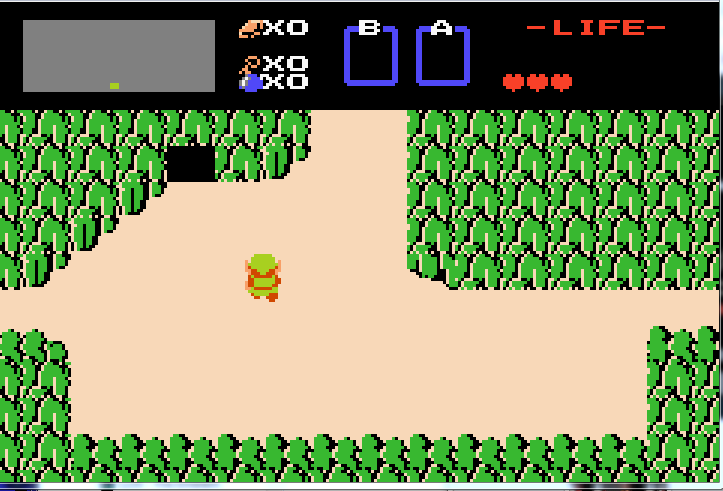
I get into the game and instantly find the classic old man cave where you learn 'caves have treasure! Go exploring in them!' and that the world you're in will require you to be equipped with a weapon, as the old man says 'It's dangerous to go alone take this!'
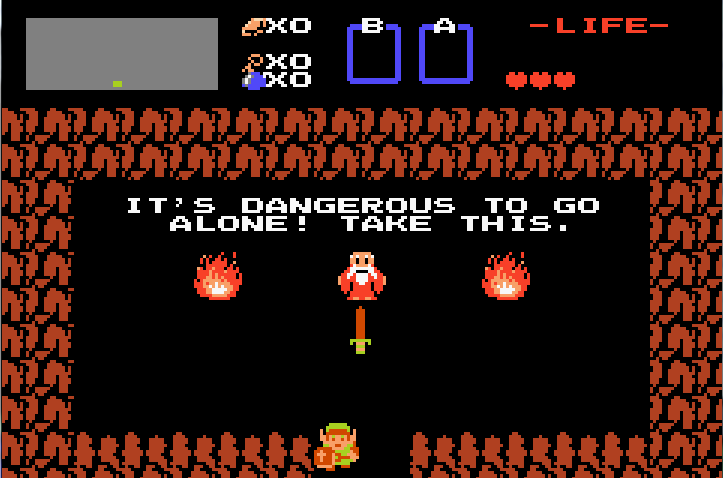
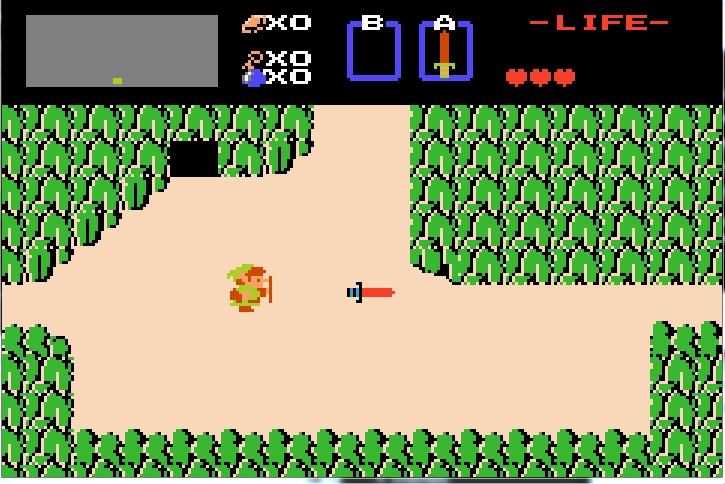
This seems a little more in game explanations orientated than Castlevania, since you're put in an environment where there is only one differing patch of pixels, so of course you go looking at it to find out what it is. The old man explicitly tells you that you have received something to fight off danger, and now to face the danger ahea- wait a moment there are lasers?
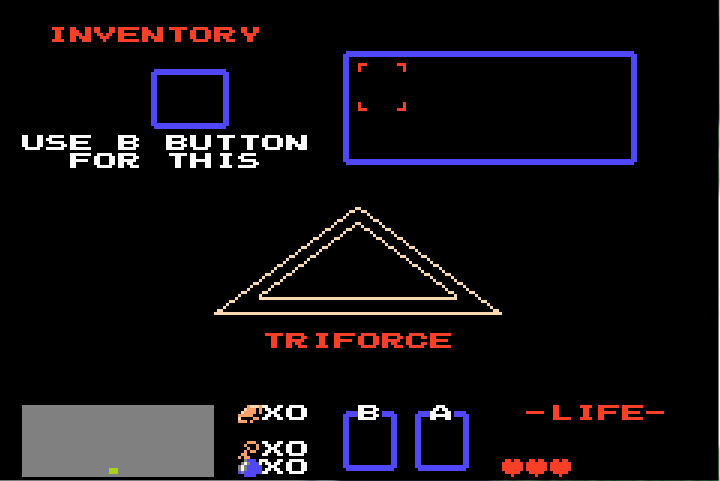
Now in Castlevania when I pushed the Start button it paused the game, pretty handy. But in Zelda you have an inventory, a record of your keys, rupees and a map. This also pauses game play, but doesn't really pause the 'game' itself. With a menu you suddenly have a lot more diversity in your game than in Castlevania. You have the option for multiple weapons, rather than just the one picked up secondary item of holy water or throwing knife like in Castlevania but I'm getting ahead of myself. Where can I find some explosives to go bomb some dodongos? Oh wait wrong installment.
As you can probably tell I really love Zelda.
Back to game play features. So here we have 'Life' labeled out for us, which is pretty neat in case you weren't familiar with game life, or hit points. In Castlevania and a lot of fighting games like Street Fighter, you just got a health bar next to your name. When you get hit and you see the bar deplete, then you understand that it represents how many hits you can take before your 'life' depletes and it's game over. I guess it's interesting to have a 'score' on Castlevania, but I don't see much point in it beyond bragging rights and a new personal best 'score' Zelda also lacks a time limit, making the journey, and not the destination the key appeal to the stages, or levels. I feel like with a time pressure in Castlevania it was more important you reached the end in time than explored every secret or random drop available.
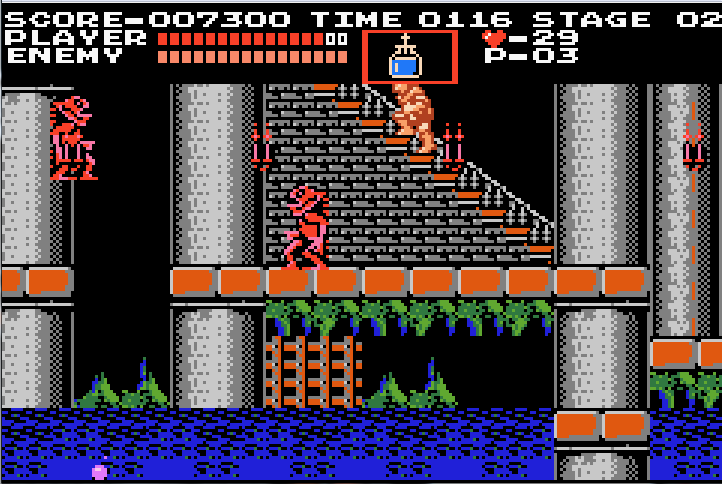
Additionally it was never really explained what 'hearts' were. They certainly don't replenish 'life.' It wasn't until the end of the stage that I found out they were score bonuses. instead health replenishing comes in the form of what the Game Grumps have influenced me to to call 'Wall Meat'.
 Yay ... ?
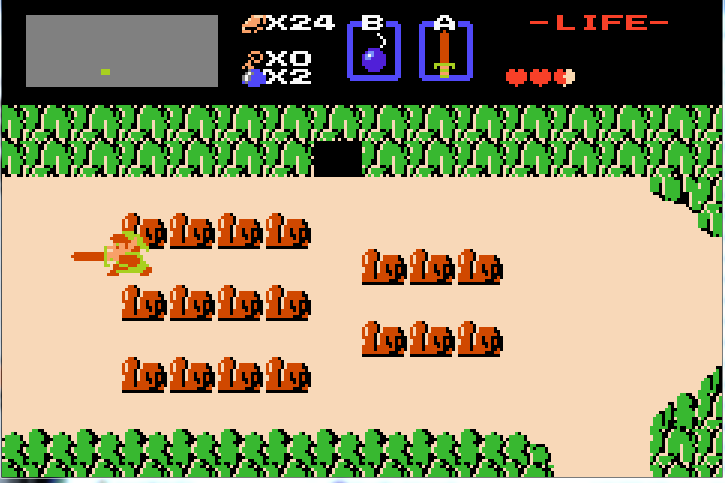
First off, again the clunky controls. I didn't figure out you had to use the 'select' command to move the selection tool, having been used to joystick commands moving the selection tool. I mean it worked that way in Castlevania. Again, this was an era where standard controls were still in the making, there was no universal A, B action button mapping. This game is from a time where sometimes A was jump and sometimes the up command was jump.
I get into the game and instantly find the classic old man cave where you learn 'caves have treasure! Go exploring in them!' and that the world you're in will require you to be equipped with a weapon, as the old man says 'It's dangerous to go alone take this!'
This seems a little more in game explanations orientated than Castlevania, since you're put in an environment where there is only one differing patch of pixels, so of course you go looking at it to find out what it is. The old man explicitly tells you that you have received something to fight off danger, and now to face the danger ahea- wait a moment there are lasers?
Old man you didn't tell me anything about lasers! I knew from previous game knowledge that you can only fire them when you have full health but I didn't know you got sword lasers right off the bat! Previously in games like Majora's Mask and Minish Cap they were a final upgrade to your weapon. But no you immediately have sword lasers, best of luck to your adventuring young sir, and may you zap your enemies with mystical cave-sword powers!
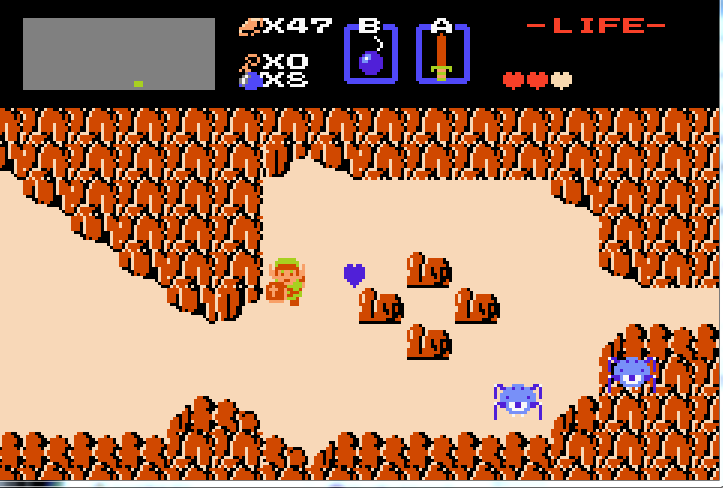
And, as is classic with Zelda games, we have a menu screen!
As you can probably tell I really love Zelda.
Back to game play features. So here we have 'Life' labeled out for us, which is pretty neat in case you weren't familiar with game life, or hit points. In Castlevania and a lot of fighting games like Street Fighter, you just got a health bar next to your name. When you get hit and you see the bar deplete, then you understand that it represents how many hits you can take before your 'life' depletes and it's game over. I guess it's interesting to have a 'score' on Castlevania, but I don't see much point in it beyond bragging rights and a new personal best 'score' Zelda also lacks a time limit, making the journey, and not the destination the key appeal to the stages, or levels. I feel like with a time pressure in Castlevania it was more important you reached the end in time than explored every secret or random drop available.
Additionally it was never really explained what 'hearts' were. They certainly don't replenish 'life.' It wasn't until the end of the stage that I found out they were score bonuses. instead health replenishing comes in the form of what the Game Grumps have influenced me to to call 'Wall Meat'.

But back to the Zelda menu. Boy that was a tangent and a half. Zelda is even more explanatory with the 'Use B Button for this' description. You could read the manual like a responsible Castlevania player would, or you could be so giddy you got a new game and completely forget about and hop right into the game and learn game mechanics on the fly until you beat the game and then read the manual to find out more.
Zelda even hints at the end goal objective with the empty 'Triforce' slot. Remember that big yellow flashing triangle thing on the game title screen? You'd think 'Yeah I wanna get that, looks like I'll have to look for it first though.' and now you have an end goal. Castevania you just kind of, go through places to find new things to kill until you find a really hard monster. Maybe if you had prior knowledge to the story of Dracula and read the novel you'd think the character might be Jonathan Harker with an Indiana Jones whip and armour about to rescue his Mina from being turned into Dracula's Stockholme Syndrome wife and ruin her 'purity' with his evil Transylvanian ways as xenophobic Victorian London was so gosh dang paranoid of. God protect the good Christian people from those impulsive foreigners ruled by lust and instinct. But no this is Simon Belmont, a guy you've never heard about in the novels, and Castlevania is not a game adaptation of Dracula it just reuses the setting and main antagonist of the original to create an interesting and new narrative with a familiar evil. However if you read the manual apparently Simon has a blood feud with Dracula, and wants to kill him to restore peace to Transylvania. I'd never have guessed. I mean you can just see the look of vengeance in Simon's dead, blank, pixelated non-eyes
That wall meat was delicious.
But maybe i'm being a bit unfair, there probably wasn't enough sophisticated programming yet to tell the story Castlevania wanted to tell, so they had to print all the backstory in the all important manual.
ANYWAY AGAIN WITH THE SIDE TRACKING FROM ZELDA
What I find interesting from Zelda is the near instantaneous reaction to pushing the A button Link would swing, and the swing would be over in about the same frame, and if not the very next frame at least. This gives the player more finely tuned controls as they can instantly react to an obstacle with little to no recovery time to react instantly to the death, or lack thereof of an enemy in succession. Swing once, instant hit, is the obstacle cleared? Instantly hit again. There is no waiting recovery period to remain exposed and vulnerable to enemy attacks. Zelda allows you to live in the moment without the need to plan ahead like Castlevania.
One thing I noticed, was the abundance of health
Understandably with a life count of three 'hearts' with a minimum damage of half a heat leading up to a max hit count of a whopping 6 is a bit unforgiving, so there is plenty of opportunity to heal up. From hearts, to fairies, to great fairies, Zelda wants you to live. It's a little misleading in Castlevania that the hearts are extra score points when we associate hearts with 'life' while the food actually heals you, but here in Zelda you see a line of symbols labeled 'life' so you know to get more life you have to get more of those symbols. The rules of the world of Zelda is a lot more intuitive and self explanatory. However there is a bit of lack in direction for Zelda, and it's clear why when you know the backstory of Miyamoto. Miyamoto wanted to create an open world to explore, hence the lack of direction. In Castlevania the stages had a clear direction. go away from where you started and eventually you end up somewhere important.In Zelda all four directions are open. In fact you start at the very bottom-center of the map. You can go to the four corners of the map to find adventure. Where you go and how far you travel is all up to you. The most direction I got was from an old hag in a cave once telling me to talk to the old man at the graveyard. Where is the graveyard in this huge place? What's with this world and old folks living in caves? Is there a hermit convention I'm not aware of?
Anyway I gave up trying to locate the graveyard when all I could find were deserts, rocks, beaches, and more cave people trying to sell me things I couldn't afford. The game pretty much tells you go look in caves to meet nice people and find neat things. Caves; Probability of finding loot and/or friendly old folks and dungeons: Weirdly High.
I do have to say the shield mechanic is weird though, because it's totally intuitive to face towards the danger you're running away from.
CASTLEVANIA FIRST IMPRESSIONS
Admittedly I couldn't get a single SNES emulator to work, they just kept crashing when I tried to load up a game. So I just used fan ports of SNES games into a Gameboy Emulator because that's what works for me.
Castlevania doesn't have much of an introduction, just throwing you in to test buttons to see what they do.
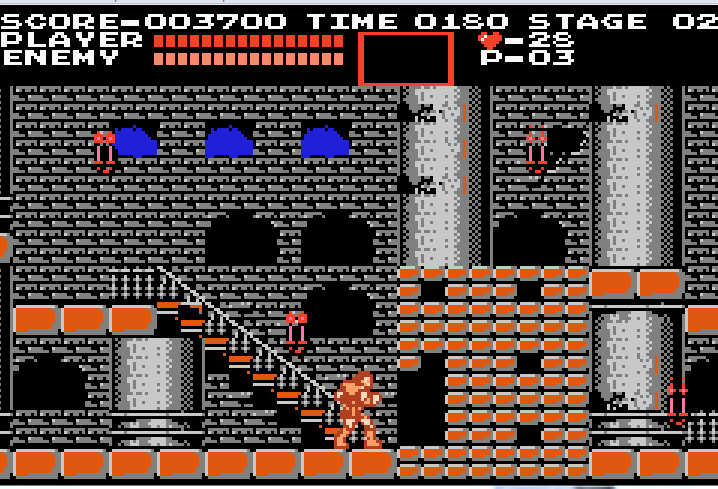
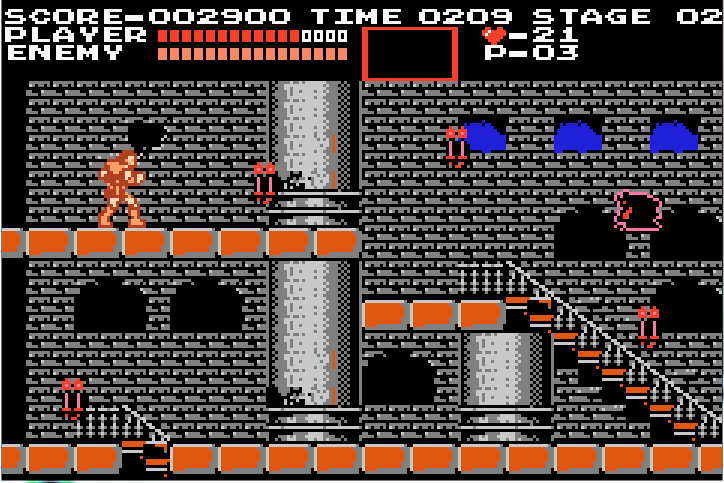 Welcome to the game "Player." You don't even get a name. Just ambiguous male character equipped with a whip to vanquish evil. Actually your character's name is Simon Belmont, but you only learn that from the instruction manual you were supposed to read and receive with the psychical copy of the game. No in game 'guide' like in most modern video games to tell you that "hey, this is who you are, this is your objective, and you have a weapon!" No, you don't get that. You were supposed to sit down, and read the manual like you'd read one to construct your Lego masterpieces.
Okay, so I get that early on video game controls were still getting their footing, should the up joystick command be for jumping, up screen movement or jumping? Like how in Megaman it was for jumping, but for some games with top overhead views like Legend of Zelda up would be upscreen motion
but WHY would you dedicate the up joystick command to solely going up stairs?
I know in later games they gave you the option for an upwards whip motion, but in this game as far as I have played, the up command is solely for going up stairs. At least the down joystick command lets you crouch as well as descend stairs, but otherwise a whole 1/2 of your joystick movement is dedicated to up and down stair traversing. How strange.
Pitfalls leave no room for error, pretty unforgiving game. You also auto-lose all your whip upgrades and secondary items upon death. Your attack also has a few frames of delay, resulting in some mildly frustrating game play and forces you to plan out your movements more carefully beyond 'if you see the thing push the hurt-y button' because you have to approach with caution so you can see and prepare for an enemy attack long before it gets into hurting range, I played only up to the second stage, by which time I was getting tired of the pitfall precision jumping. So I loaded up Legend of Zelda instead, feeling that I had sufficiently experienced the basics of Castlevania's game play design.
Admittedly I couldn't get a single SNES emulator to work, they just kept crashing when I tried to load up a game. So I just used fan ports of SNES games into a Gameboy Emulator because that's what works for me.
Castlevania doesn't have much of an introduction, just throwing you in to test buttons to see what they do.
Okay, so I get that early on video game controls were still getting their footing, should the up joystick command be for jumping, up screen movement or jumping? Like how in Megaman it was for jumping, but for some games with top overhead views like Legend of Zelda up would be upscreen motion
but WHY would you dedicate the up joystick command to solely going up stairs?
Pitfalls leave no room for error, pretty unforgiving game. You also auto-lose all your whip upgrades and secondary items upon death. Your attack also has a few frames of delay, resulting in some mildly frustrating game play and forces you to plan out your movements more carefully beyond 'if you see the thing push the hurt-y button' because you have to approach with caution so you can see and prepare for an enemy attack long before it gets into hurting range, I played only up to the second stage, by which time I was getting tired of the pitfall precision jumping. So I loaded up Legend of Zelda instead, feeling that I had sufficiently experienced the basics of Castlevania's game play design.
Subscribe to:
Posts (Atom)